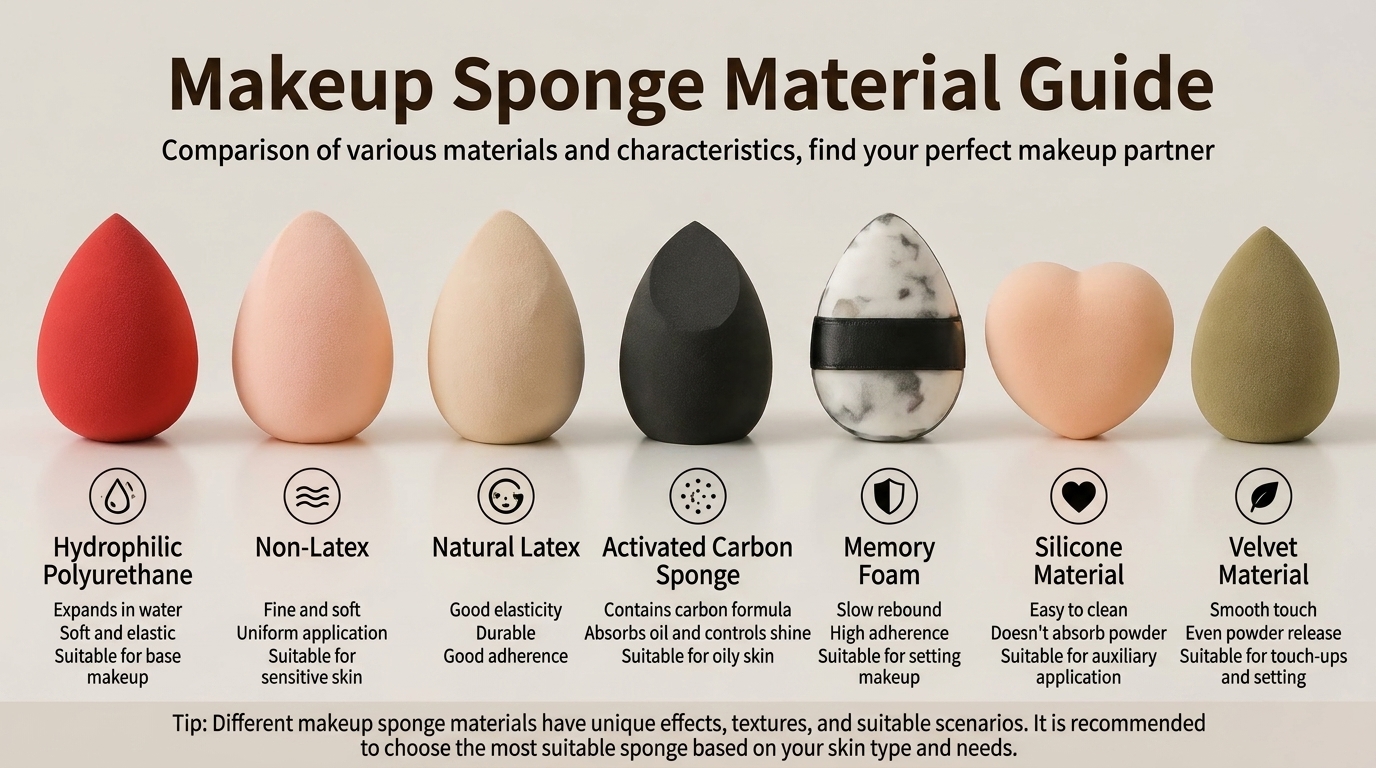
Choosing the right makeup sponge material is one of the most consequential decisions a B2B buyer makes — and one of the least explained. Most suppliers hand you a sample, tell you it's "good quality," and leave you to figure out the rest. The reality is that the two dominant materials in today's market — NBR (Nitrile Butadiene Rubber) and HPU (Hydrophilic Polyurethane) — perform very differently under real-world conditions. Understanding those differences before you place a bulk order can be the difference between a product that wins repeat customers and one that gets returned. 选择正确的美妆蛋材料是B2B采购商最关键的决策之一,也是市场上解释最少的一个环节。大多数供应商给你一个样品,说质量很好,然后让你自己摸索。现实是:当今市场两大主流材料——NBR(丁腈橡胶)和HPU(亲水性聚氨酯)——在实际使用条件下表现差异显著。在批量下单前理解这些差异,决定了你的产品是赢得回头客还是遭遇退货。
What Are NBR and HPU — and Why Does the Difference Matter? 什么是NBR和HPU——为什么材料差异如此重要?
NBR is a closed-cell synthetic rubber foam; HPU is an open-cell water-loving polyurethane foam. That single structural difference — closed cell vs. open cell — drives every downstream performance variable that actually matters to your end customer: how the product feels on skin, how much foundation it wastes, how long it lasts, and how easy it is to clean. NBR是闭孔合成橡胶泡沫;HPU是开孔亲水性聚氨酯泡沫。这一个结构差异——闭孔与开孔——决定了所有对终端客户真正重要的性能变量:产品上脸的触感、粉底液的浪费程度、使用寿命以及清洁难易度。
NBR foam is the traditional choice. It's denser, more resilient, and has a slightly rubbery feel when dry. It does not absorb water, which means it also resists absorbing foundation — making it a popular choice for dry application techniques. HPU foam, by contrast, swells when wet. This expansion is not a defect; it's the core mechanism that makes it work. Wet HPU foam becomes softer, bouncier, and applies liquid foundation with a significantly sheerer, more skin-like finish — the effect consumers associate with the original beauty blender style applicator. NBR泡沫是传统选择。它更密实、弹性更强,干燥时触感略带橡胶感。它不吸水,因此也不吸收粉底液——这使其成为干涂技法的热门选择。相比之下,HPU泡沫遇水会膨胀。这种膨胀不是缺陷,而是其核心工作机制。湿润的HPU泡沫变得更柔软、更有弹性,上妆后粉底液的效果更自然、更贴肤——这正是消费者对美妆蛋风格海绵的期待效果。
NBR vs HPU: Performance Data Your Supplier Won't Volunteer NBR与HPU性能数据:供应商不会主动告诉你的真相
Most buyers compare materials by feel. The problem is that feel at room temperature — before the sponge is ever used on skin — is a poor predictor of in-use performance. Here is what the actual physical data shows. 大多数采购商凭手感对比材料。问题在于,室温下(产品被使用前)的触感,对实际使用性能的预测能力很差。以下是真实的物理数据所呈现的情况。
| Property属性 | NBR FoamNBR泡沫 | HPU FoamHPU泡沫 |
|---|---|---|
| Cell structure孔结构 | Closed-cell闭孔 | Open-cell开孔 |
| Water absorption吸水率 | Low (<5%)低(<5%) | High (swells 130–150%)高(膨胀130–150%) |
| Dry application干涂效果 | Excellent优秀 | Moderate一般 |
| Wet application (liquid foundation)湿涂效果(液体粉底) | Moderate一般 | Excellent优秀 |
| Typical Shore A hardness (dry)邵氏硬度(干燥) | 35–45 Shore A35–45邵氏A | 20–30 Shore A20–30邵氏A |
| Latex-free无乳胶 | Yes是 | Yes是 |
| EU market compliance (EC 1223/2009)欧盟市场合规性 | Achievable with REACH SDS需提供REACH符合性声明 | Achievable with REACH SDS需提供REACH符合性声明 |
| Typical MOQ (Joyning Beauty)最低起订量(Joyning Beauty) | 500 pcs500个 | 500 pcs500个 |
Factory Insight from Jiangmen: 江门工厂一线数据:
In our Jiangmen production facility, every batch of HPU beauty sponges undergoes a wet-expansion test before it ships. The standard we hold to: HPU foam must reach 130–150% of its dry volume when submerged in 25°C water for 60 seconds. Foam that expands below 130% has insufficient porosity — it feels stiff when wet and consumers report it "tugs" at skin. Foam that expands beyond 155% is too soft, loses its shape during blending, and wears out prematurely. This 20-percentage-point window is what separates a beauty sponge that earns five-star reviews from one that gets returned. NBR, by comparison, expands less than 5% under the same conditions — which is exactly why it performs differently and suits a different application method. 在我们的江门生产工厂,每批HPU美妆蛋出货前都要进行湿膨胀测试。我们的质检标准是:HPU泡沫在25°C水中浸泡60秒后,必须达到干燥体积的130%–150%。膨胀率低于130%说明孔隙度不足——湿润后手感偏硬,消费者会反映上脸有"拉扯感"。膨胀率超过155%则过软,打圈上妆时容易变形,且磨损速度过快。这20个百分点的区间,是决定一款美妆蛋能否获得五星好评的关键。相比之下,NBR在同等条件下的膨胀率不足5%——这正是它性能不同、适合不同上妆方式的根本原因。
What European B2B Buyers Are Asking for in 2026 2026年欧洲B2B采购商的核心诉求
Material preference in the European market is not uniform — it varies by channel, price point, and end consumer demographic. Based on enquiries we receive from German, UK, and French buyers, here is what we observe on the ground. 欧洲市场的材料偏好并不统一——它因销售渠道、价格定位和终端消费者群体的不同而有所差异。根据我们收到的德国、英国和法国采购商咨询,以下是我们在实际业务中观察到的情况。
~70% of European private label inquiries we receive specify HPU for liquid foundation applicators; NBR dominates powder and baking product lines. 我们收到的欧洲自有品牌询盘中,约70%的液体粉底海绵要求HPU材料;粉饼和定妆产品线则以NBR为主。
The more important market reality, however, is compliance. Entering the EU market with any makeup applicator requires meeting EC Regulation 1223/2009. A latex-free claim — increasingly demanded by European retailers and consumers with sensitive skin — is not a single certificate. It requires a full REACH compliance declaration (SDS document) from your raw material supplier's upstream chain. Both NBR and HPU can be made latex-free, but you need paperwork proving the entire upstream supply chain is free of natural rubber latex. Buyers who skip this step face product delisting at European retail, regardless of how good the sponge feels. 然而,更重要的市场现实是合规问题。任何美妆工具进入欧盟市场都必须符合EC 1223/2009法规。欧洲零售商和敏感肌消费者日益要求的"无乳胶"声明,并非一张证书那么简单。它需要原材料供应商的完整上游供应链提供REACH符合性声明(SDS文件)。NBR和HPU都可以做到无乳胶,但你需要文件来证明整个上游供应链不含天然橡胶乳胶。忽略这一步的采购商,无论产品手感多好,都面临被欧洲零售商下架的风险。
A Practical Material Selection Framework for B2B Buyers B2B采购商的实用材料选择框架
Before requesting samples, answer these four questions. Your answers map directly to the right material choice. 在要求样品之前,先回答以下四个问题。你的答案将直接指向正确的材料选择。
1. What foundation format are your end customers using? Liquid and cream foundations → HPU. Pressed powder, setting powder, baking powder → NBR. If your line covers both, you may need two SKUs with different materials, not one sponge trying to do everything. 1. 你的终端客户使用什么粉底剂型?液体和膏状粉底→HPU。饼状粉、定妆粉、烘焙粉→NBR。如果你的产品线涵盖两者,可能需要两个使用不同材料的SKU,而不是一款试图兼顾一切的海绵。
2. What is your retail price point? HPU costs 15–25% more to produce than NBR at equivalent density and quality grade. If your retail price is below €8, HPU may squeeze your margin significantly; NBR is the pragmatic choice at the value end. Above €15, HPU's performance story justifies both the cost and a premium positioning narrative. 2. 你的零售价格区间是多少?在同等密度和质量等级下,HPU的生产成本比NBR高15–25%。如果你的零售价低于8欧元,HPU可能会大幅压缩利润;NBR在大众价位是务实之选。超过15欧元时,HPU的性能故事足以支撑成本,并形成高端定位叙事。
3. Are you entering the German or Nordics market? German consumers and retailers have above-average scrutiny of material transparency and allergenic ingredients. A dual-material spec sheet and third-party test report (SGS or Intertek preferred) are non-negotiable for most German retail buyers. At Joyning Beauty, we support buyers entering these markets with our 500+ design catalogue and provide full material compliance documentation on request. 3. 你是否在进入德国或北欧市场?德国消费者和零售商对材料透明度和过敏原成分的审查高于平均水平。双材料规格说明书和第三方检测报告(首选SGS或Intertek)是大多数德国零售买家的必要条件。在Joyning Beauty,我们凭借500+款设计目录支持进入这些市场的买家,并应要求提供完整的材料合规文件。
4. How will your customer clean and store the sponge? This is the durability question buyers rarely ask until returns arrive. HPU foam, if not fully dried after each use, is more prone to mold growth inside the open-cell structure. NBR's closed-cell structure resists moisture retention and is more forgiving of consumers who don't follow cleaning instructions. For salon and professional use — where applicators are cleaned frequently but sometimes imperfectly — NBR tends to have longer field life. 4. 你的客户如何清洁和存放海绵?这是采购商很少主动问、直到退货来了才后悔没问的耐用性问题。HPU泡沫每次使用后若未完全干燥,开孔结构内部更容易滋生霉菌。NBR的闭孔结构抗潮湿滞留能力更强,对不严格执行清洁指引的消费者更宽容。在沙龙和专业使用场景中——海绵被频繁清洁但有时清洁不彻底——NBR往往具有更长的实际使用寿命。
The Bottom Line 核心结论
The right makeup sponge material is not NBR or HPU — it is the material that matches your product's intended use, your target market's compliance requirements, and your retail price architecture. HPU wins on liquid foundation performance and premium consumer experience; NBR wins on durability, dry application versatility, and cost efficiency. Both are latex-free, both can meet EU standards, and both are available with full OEM/ODM customization at Joyning Beauty's Jiangmen facility. What you need before placing your first bulk order is not a better sample — it is a clear set of questions to ask your supplier, and a supplier that gives you real answers instead of vague assurances. 正确的美妆蛋材料不是NBR或HPU的非此即彼——而是与你产品的预期用途、目标市场的合规要求以及零售价格体系相匹配的材料。HPU在液体粉底上妆效果和高端消费体验方面占优;NBR在耐用性、干涂多功能性和成本效益方面更具优势。两者均无乳胶,均可达到欧盟标准,均可在Joyning Beauty江门工厂提供完整的OEM/ODM定制。在下第一笔批量订单之前,你需要的不是更好的样品——而是向供应商提出正确的问题,以及一个给你真实答案而非模糊保证的供应商。
If you are evaluating suppliers, request a dual-material sample set — one NBR and one HPU at the same density grade and size. Apply both wet and dry. Ask for the Shore A hardness spec sheet and the REACH SDS document for the raw material. Any factory with serious B2B experience will have these ready. If they don't, that's your answer. 如果你正在评估供应商,建议要求一套双材料样品——相同密度等级和尺寸的NBR和HPU各一个。分别进行湿涂和干涂测试。要求提供邵氏硬度规格说明书和原材料的REACH SDS文件。任何有B2B经验的工厂都应该随时准备好这些资料。如果他们没有,这本身就是你的答案。