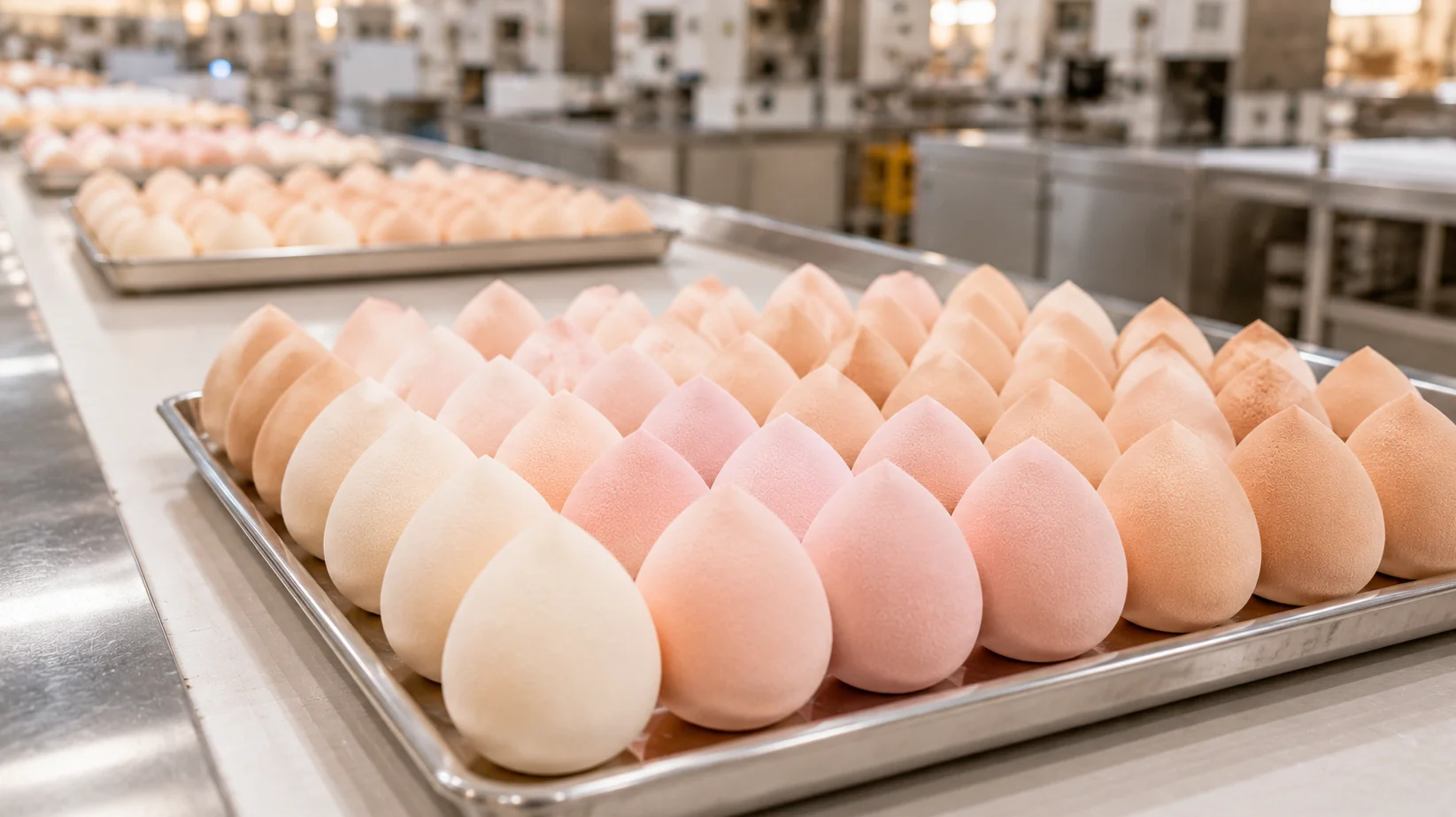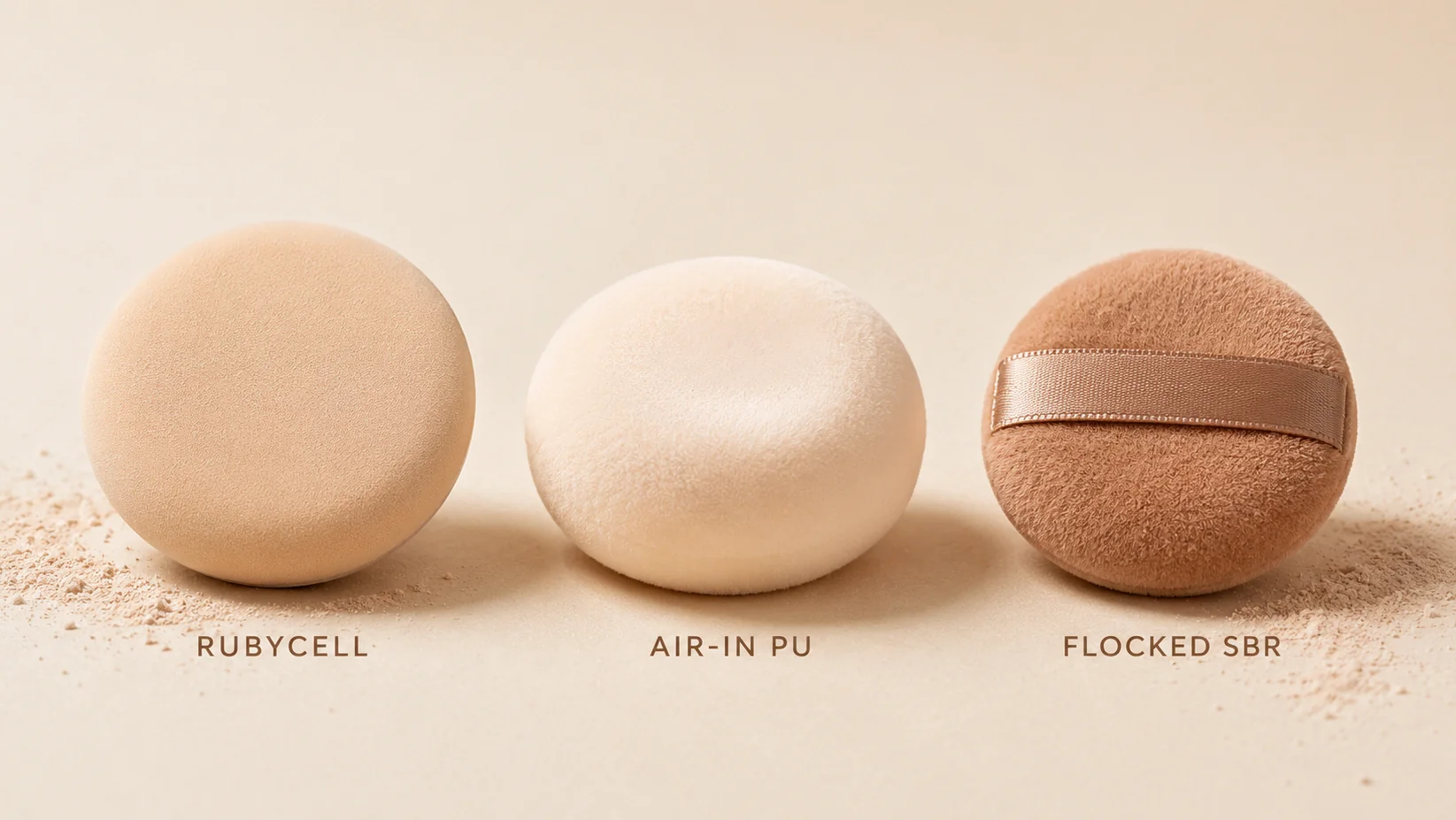
The powder puff construction you approve at the sample stage can affect how the finished puff picks up and releases product, how its surface behaves in use, and how it performs after cleaning. Shape and color alone do not define those results. This guide compares RUBYCELL microporous PU, supplier-described Air-in PU, and flocked SBR constructions through a B2B sourcing framework, so you can define specifications, sample tests, documentation, and quotation requirements before a bulk order. 你在打样阶段确认的粉扑构造,会影响成品如何取粉与释粉、表面在使用中的表现,以及清洁后的状态;仅凭形状和颜色无法确定这些结果。本文通过B2B采购框架,对比RUBYCELL微孔PU、供应商所称的Air-in PU和植绒SBR构造,帮助你在下批量订单前明确规格、样品测试、文件与报价要求。
What Rubycell, Air-in PU, and Flocked SBR Actually Are Rubycell、Air-in PU与植绒SBR到底是什么
These are foam-based constructions, but a material label alone does not predict application performance. Cell structure, density, hardness, thickness, surface treatment, the complete construction, and the cosmetic formula can all affect pickup and release. 这些都是以泡棉为基础的构造,但仅凭材质名称无法预测上妆表现。孔结构、密度、硬度、厚度、表面处理、完整成品构造及化妆品配方,都可能影响取粉与释粉。
- RUBYCELL is Toyo Polymer's registered trademark for a special microporous polyurethane sponge, not a generic material class. Manufacturer and grade should be identified in the specification. A supplier's claim that another foam is "equivalent" requires matched specifications and finished-product testing; the name alone does not establish pickup, release, or quality. RUBYCELL 是Toyo Polymer特殊微孔聚氨酯海绵的注册商标,并非通用材质类别。规格中应明确制造商与牌号。供应商声称其他泡棉“同等”时,需要用匹配规格与成品测试验证;名称本身不能证明取粉、释粉或质量表现。
- Air-in PU is not a universal standardized technical grade; it is a supplier or product description. The PU formulation, cell structure, surface treatment, hardness, density, and thickness can vary by supplier. If hydrophilic performance or a particular hand-feel is required, define it in the specification and validate the finished sample with the intended formula. Air-in PU 是供应商或产品描述,并非统一标准化的技术牌号。不同供应商的PU配方、孔结构、表面处理、硬度、密度与厚度可能不同。如需亲水表现或特定手感,应写入规格,并用预定配方验证成品样品。
- Flocked SBR generally describes an SBR-based foam with an applied short-fiber surface. The complete construction may also include adhesives, coatings, and other components. Surface feel, flock adhesion, shedding, pickup, and release should therefore be assessed on the finished puff rather than inferred from the SBR label. 植绒SBR 通常指以SBR泡棉为基础、表面覆有短纤维的构造;完整成品还可能包含胶黏剂、涂层及其他组件。因此,应在成品粉扑上评估表面手感、植绒附着、掉屑、取粉与释粉,而不能仅从SBR名称推断。
Powder Puff Material Comparison: What Buyers Should Verify 粉扑材质对比:采购商应核验什么
Hand-feel alone does not establish pickup, release, skin-contact suitability, or cleaning durability. Those outcomes depend on the finished construction and use conditions. The table below turns unsupported universal rankings into specification, documentation, and test questions for each candidate. 仅凭手感无法确定取粉、释粉、皮肤接触适用性或清洁耐久性;这些结果取决于完整成品构造与使用条件。下表不作缺乏证据的通用排名,而是把每种候选方案转化为规格、文件与测试问题。
| Property属性 | RUBYCELL (branded microporous PU)RUBYCELL(品牌微孔PU) | Supplier-described Air-in PU供应商所称Air-in PU | Flocked SBR construction植绒SBR构造 |
|---|---|---|---|
| Surface structure表面结构 | Microporous PU; verify manufacturer and grade微孔PU;核验制造商与牌号 | PU construction; obtain the supplier's technical definitionPU构造;索取供应商技术定义 | SBR-based foam with applied flocking; verify full BOMSBR基泡棉加植绒;核验完整BOM |
| Powder release evenness粉体释放均匀度 | Not rankable by name; test the finished sample with the intended formula不能按名称排名;用预定配方测试成品样品 | Not rankable by name; test the finished sample with the intended formula不能按名称排名;用预定配方测试成品样品 | Not rankable by name; test the finished sample with the intended formula不能按名称排名;用预定配方测试成品样品 |
| Formula fit配方适配 | Validate with the intended formula and application method用预定配方与上妆方法验证 | Validate with the intended formula and application method用预定配方与上妆方法验证 | Validate with the intended formula and application method用预定配方与上妆方法验证 |
| Skin-feel肤感 | Depends on grade, density, hardness, thickness and finish取决于牌号、密度、硬度、厚度与表面处理 | Depends on supplier construction and specification取决于供应商构造与规格 | Depends on foam, fiber, adhesive and finish取决于泡棉、纤维、胶黏剂与表面处理 |
| Skin-contact / shedding assessment皮肤接触 / 掉屑评估 | Assess full BOM and finished construction; test as applicable评估完整BOM与成品构造;按适用情况测试 | Assess full BOM and finished construction; test as applicable评估完整BOM与成品构造;按适用情况测试 | Assess full BOM and finished construction; include flock-adhesion and shedding tests评估完整BOM与成品构造;包括植绒附着与掉屑测试 |
| Natural rubber latex status天然橡胶乳胶状态 | Not established by the material name; verify the full BOM and evidence不能由材质名称确定;核验完整BOM与证据 | Not established by the material name; verify the full BOM and evidence不能由材质名称确定;核验完整BOM与证据 | Not established by the SBR base; verify flock, adhesive and all components不能由SBR基材确定;核验绒毛、胶黏剂及全部组件 |
| Cleaning durability清洁耐久性 | No general cycle rating; validate the finished construction with a defined test无通用循环次数;用明确方法验证成品构造 | No general cycle rating; validate the finished construction with a defined test无通用循环次数;用明确方法验证成品构造 | No general cycle rating; include abrasion, flock-adhesion and shedding criteria无通用循环次数;纳入摩擦、植绒附着与掉屑判据 |
| B2B unit costB端单价 | Configuration-specific; obtain a like-for-like quotation按配置而定;索取同规格报价 | Configuration-specific; obtain a like-for-like quotation按配置而定;索取同规格报价 | Configuration-specific; obtain a like-for-like quotation按配置而定;索取同规格报价 |
| MOQ起订量 | Configuration-specific; confirm in the written quotation按配置而定;以书面报价确认为准 | Configuration-specific; confirm in the written quotation按配置而定;以书面报价确认为准 | Configuration-specific; confirm in the written quotation按配置而定;以书面报价确认为准 |
Specification and Test Insight: 规格与测试要点:
Specify more than the material name. Density may affect firmness and compression, but it does not predict pickup or release on its own. Record the manufacturer and grade where relevant, plus density, hardness, thickness, pore or surface description, full construction, and the intended cosmetic formula. For flocked products, define a repeatable flock-adhesion and shedding method and document acceptance criteria before production. The buyer's request should therefore cover the complete specification and test method, because a material label alone is not a complete specification. 规格不能只有材质名称。密度可能影响硬度与压缩,但不能单独预测取粉或释粉。应记录适用的制造商与牌号,以及密度、硬度、厚度、孔或表面描述、完整构造和预定化妆品配方。对植绒产品,应定义可复现的植绒附着与掉屑方法,并在量产前记录验收标准。因此,采购要求应覆盖完整规格与测试方法,因为仅有材质名称并不是完整规格。
Need side-by-side samples of RUBYCELL, supplier-described Air-in PU, and flocked SBR with documented specifications? 需要一组附有明确规格的RUBYCELL、供应商所称Air-in PU与植绒SBR对照样品?
Request a B2B Sample & Quote 提交B2B询盘与样品申请Documentation Questions for European & US Markets in 2026 2026年欧美市场的文件核验问题
Do not infer a material preference from a region or sales channel. For each destination market, define the finished product, intended use, claims, route to market, and required evidence before selecting a construction. 不要从地区或销售渠道推断材质偏好。针对每个目的市场,应先明确成品、预期用途、宣传声明、上市路径与所需证据,再选择构造。
A material name is not a substitute for a product specification, compliance assessment, finished-sample test, or like-for-like quotation. 材质名称不能替代产品规格、合规评估、成品样品测试或同规格报价。
For an EU-bound product, determine the finished construction, intended use, claims, and how it is placed on the market. The EU Cosmetics Regulation (EC) No 1223/2009 applies to cosmetic products as defined by that regulation; a standalone applicator is not automatically covered simply because it is used with cosmetics. Other obligations may still apply, including the General Product Safety Regulation for consumer products and applicable REACH duties. If the applicator is supplied with a cosmetic or in a kit, assess the complete offering and its market placement. A "latex-free" claim also cannot be inferred from a PU or SBR base. Verify the full bill of materials — including adhesives, flocking, coatings, inks, and other components — using appropriate supplier evidence and product-specific testing where needed. No single document or material name proves overall EU compliance. 对面向欧盟的产品,应先确定成品构造、预期用途、宣传声明及上市方式。欧盟化妆品法规((EC) 1223/2009)适用于该法规所定义的化妆品;独立销售的上妆工具不会仅因用于化妆品就自动受该法规直接管辖。其他义务仍可能适用,包括面向消费者产品的《通用产品安全法规》以及适用的REACH义务。如果上妆工具与化妆品一起供应或组成套装,应评估完整产品组合及其上市方式。“无乳胶”声明同样不能从PU或SBR基材推断;应核验包含胶黏剂、植绒、涂层、油墨及其他组件在内的完整BOM,并在需要时使用适当供应商证据与针对成品的测试。任何单一文件或材质名称都不能证明整体欧盟合规。
Keep packaging obligations separate from puff-material claims. The EU Packaging and Packaging Waste Regulation concerns packaging placed on the EU market; it does not by itself substantiate recycled-content, bio-based, washable, reusable, or other environmental claims about the puff. Any such claim should be supported by product-specific evidence and a defined test or chain-of-custody method appropriate to the claim. If "reusable" or a wash-cycle statement will appear on pack, validate the finished construction under a documented protocol before approval. 应把包装义务与粉扑材质声明分开。欧盟《包装和包装废弃物法规》针对投放欧盟市场的包装;它本身不能证明粉扑具有再生含量、生物基、可水洗、可复用或其他环保属性。任何此类声明都应由针对成品的证据,以及与声明相适应的明确测试或产销监管链方法支持。如包装上将出现“可复用”或清洗次数声明,应在批准前按书面方案验证完整成品构造。
A Practical Material Selection Framework for B2B Buyers B2B采购商的实用选材框架
Before you request samples, answer these four questions. The answers define what suppliers should quote, document, and sample; they do not produce a universal material ranking. 在申请样品之前,先回答这四个问题。答案用于明确供应商应报价、提供文件与打样的内容,而不是得出通用材质排名。
1. What formula will the puff actually carry? Record whether the product is pressed, loose, or liquid, together with relevant formula and application conditions. Request finished samples of each candidate construction and compare pickup, release, finish, and cleaning behaviour using the same formula and test method. 1. 粉扑实际承载什么配方?记录产品是压粉、散粉还是液体,以及相关配方与上妆条件。索取各候选构造的成品样品,用同一配方与测试方法对比取粉、释粉、妆效与清洁后表现。
2. What is your retail price architecture? There is no universal cost order based only on the labels RUBYCELL, Air-in PU, and flocked SBR. Compare like-for-like written quotations that include the exact material identity or supplier definition, dimensions, construction, decoration, packaging, tooling, order quantity, and commercial terms. 2. 你的零售价格体系是怎样的?仅凭RUBYCELL、Air-in PU与植绒SBR名称,无法建立通用成本排序。应对比同规格书面报价,内容包括准确材质身份或供应商定义、尺寸、构造、装饰、包装、模具、订单数量与商务条款。
3. Which market and channel? Identify the destination's legal requirements, retailer or marketplace specifications, product claims, and foreseeable complaint risks. Do not assume that a region or channel prefers one material; document the evidence required for the exact finished product. 3. 面向哪个市场和渠道?识别目的地法律要求、零售商或平台规格、产品声明及可预见投诉风险。不要假定某个地区或渠道偏好某种材质;应明确该成品所需的具体证据。
4. Custom shape or existing tooling? Ask each supplier whether the exact shape and dimensions use existing tooling or require new tooling. If new tooling is required, obtain the tooling charge, lead time, sample plan, MOQ, and ownership terms in writing. Do not infer tooling availability or MOQ from the shape name alone. 4. 定制形状还是现有模具?向每个供应商确认准确形状与尺寸是使用现有模具还是需要新开模。如需新模,应书面取得模具费用、交期、打样方案、MOQ与模具归属条款。不要仅从形状名称推断模具可用性或MOQ。
Joyning Beauty coordinates powder puff sourcing discussions with partner factories in Jiangmen, Guangdong. Available materials, grades, shapes, tooling, OEM/ODM services, MOQ, and supporting documentation are project-specific and should be confirmed for the exact configuration before approval. Joyning Beauty与广东江门的合作工厂协调粉扑采购。可提供的材质、牌号、形状、模具、OEM/ODM服务、MOQ及配套文件均按项目而定,应在批准前针对准确配置确认。
The Bottom Line 核心结论
There is no single best powder puff material and no defensible universal ranking for release, durability, sensitization, cost, or compliance. Compare candidate finished constructions against the intended formula, use conditions, destination market, and written quotation. Record the exact manufacturer or supplier definition, grade, full BOM, dimensions, surface construction, and relevant test methods instead of approving on hand-feel or material name alone. 不存在唯一最优的粉扑材质,也不存在对释粉、耐久、致敏、成本或合规的可靠通用排名。应根据预定配方、使用条件、目的市场与书面报价,对比候选成品构造;记录准确制造商或供应商定义、牌号、完整BOM、尺寸、表面构造及相关测试方法,而不是仅凭手感或材质名称批准。
If you are evaluating suppliers, request finished samples with comparable size and thickness and documented construction variables, then test each with the intended formula under the same method. Ask for the documents appropriate to the specific material and finished product, such as technical specifications, full-BOM declarations, and an SDS only where one is applicable or legally required. Missing an SDS alone does not prove supplier inadequacy, because SDS duties depend on the substance, mixture, or article status; first determine which document is required and then evaluate the supplier's response. 如果你正在评估供应商,应索取尺寸与厚度可比、并记录构造变量的成品样品,再用预定配方按同一方法测试。要求与具体材质和成品相适应的文件,例如技术规格、完整BOM声明,以及仅在适用或法律要求时提供的SDS。仅缺少SDS不能证明供应商不合格,因为SDS义务取决于对象属于物质、混合物还是物品;应先确定所需文件,再评估供应商回应。
Frequently Asked Questions 常见问题
What is the MOQ for custom private label powder puffs? 定制自有品牌粉扑的起订量(MOQ)是多少?
MOQ is configuration-specific and can vary with the supplier, material construction, shape, size, color, decoration, packaging, tooling, and commercial terms. Confirm the MOQ for the exact specification in a written quotation. MOQ按配置而定,并可能随供应商、材质构造、形状、尺寸、颜色、装饰、包装、模具及商务条款变化。请以针对准确规格的书面报价确认为准。
Which powder puff material releases the most powder evenly? 哪种粉扑材质粉体释放最均匀?
No material can be ranked universally by its name alone. Pickup and release depend on the finished construction, including pore structure, density, hardness, thickness and surface, as well as the powder formula. Compare finished samples with the intended formula under the same test method. 不能仅凭材质名称作通用排名。取粉与释粉取决于包括孔结构、密度、硬度、厚度与表面在内的完整成品构造,也取决于粉体配方。请用预定配方在同一测试方法下对比成品样品。
Are Rubycell and air-in PU powder puffs latex-free and EU-compliant? Rubycell与air-in PU粉扑是否无乳胶且符合欧盟合规?
Material names alone do not establish that a finished puff is free of natural rubber latex or compliant for the EU market. Verify the complete BOM, supplier declarations, and any product-specific testing required. The EU Cosmetics Regulation does not automatically apply to a standalone applicator simply because it is used with cosmetics; other EU obligations, including applicable product-safety and REACH requirements, may still apply. Assess the finished product, intended use, claims, and route to market. 仅凭材质名称不能确定成品粉扑不含天然橡胶乳胶,也不能确定其符合欧盟市场要求。应核验完整BOM、供应商声明及所需的成品测试。独立销售的上妆工具不会仅因用于化妆品就自动受欧盟化妆品法规直接管辖;其他欧盟义务仍可能适用,包括适用的产品安全与REACH要求。应评估成品、预期用途、声明及上市路径。